What is the Purpose of Prosthetics?
What is a Prosthetic?
A prosthetic is an artificial substitute or replacement of a part of the body such as a tooth, eye, a facial bone, the palate, a hip, a knee or another joint, the leg, an arm, etc. Prosthetics are made for use by anyone that has lost a limb. Some people also use prosthetics for a little extra help getting around even if they haven’t lost a limb. People of all ages have the ability to sustain prosthetic rehabilitation and an artificial limb can improve mobility and the ability to manage daily activities, as well as provide the means to stay independent.
Types of Prosthetics
There are four main types of artificial limbs, and their usage depends on what part of a limb is missing. Each type requires different approaches to regaining functions after amputation, as well as customizations and unique considerations to be accounted for in order to use an artificial limb to its fullest potential.
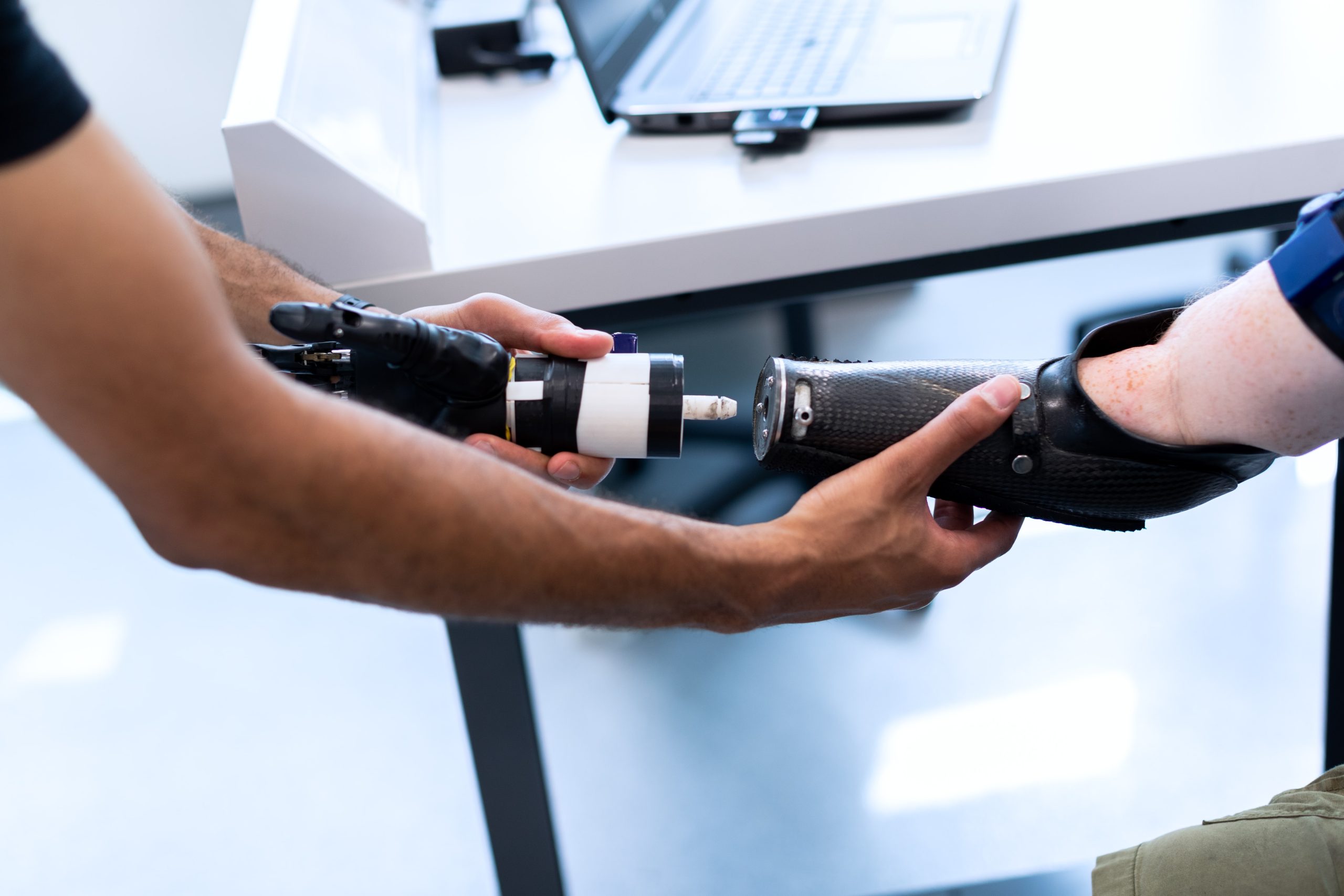
- Transradial – A transradial prosthesis is an artificial wearable limb attached below the elbow, which provides the appearance and functionality of a human wrist and hand. There are two types of transradial prosthesis: the passive and active prosthesis. A passive prosthesis, also known as a cosmetic prosthesis, serves strictly for appearance and does not move. An active prosthesis has two forms: the conventional and myoelectric prosthesis. A conventional or body-powered prosthesis connects to the affected shoulder and other arm through a series of cables, allowing the individual to manually control their movement. A myoelectric prosthesis is the newest and most advanced form of transradial prosthesis which detects muscle movement in the arm with the help of specialized sensors and allows the movement of the prosthesis.
- Transhumeral – A transhumeral prosthesis is an artificial limb that connects the body above the elbow, providing the appearance and functionality of an arm. Due to a missing elbow, this is one of the challenging prostheses in terms of mimicking the correct motion and doing complex movements of the elbow.
- Transtibial – A transtibial prosthesis is an artificial leg that replaces the appearance and/or function of missing anatomical segment(s) below the knee. It has a socket that connects the residual limb to the prosthesis, which distributes weight accordingly and provides comfort.
- Transfemoral – A transfemoral prosthesis is an artificial limb that replaces a missing leg above the knee. It has a solid ankle cushion heel, hexagonal-head bolt and lock washer, convex ankle, concave cylinder and pin, set of washers with a nut and bolt, convex disc, conical cup, trans-femoral cup, and knee shell which allow for normal movement and function of the prosthetic leg. It is the most challenging prosthesis because it must be fitted properly and requires a lengthy rehabilitation process.
History of Prosthetics
The first use of artificial limbs dates back to 3000 years ago by the Ancient Egyptians. Historians discovered several ancient stories referencing artificial body parts, from a woman with a wooden prosthetic toe attached to her foot via a leather strap, to pirates restoring walking through the use of wooden legs. Most people back then couldn’t afford prosthetics made, so they created their own from wooden chairs or table legs, and referred to them as a “peg leg”. There is also evidence that Roman General Marcus Sergius used a prosthesis. He had an iron hand designed for him after losing his right hand, which helped him return to battle.
Over the years, prosthetics have developed significantly with the help of technological improvements. In the early 1990s, Blatchford developed the first artificial knee with an “on board” computer to improve the symmetry of amputees’ gait and give a more reliable gait pattern during the swing phase of the gait cycle. With these “intelligent prostheses”, amputees can walk with more confidence. New advancements of prosthetics include microprocessor-driven and activity-specific components, improved materials and design for better range of motion and can be integrated more seamlessly with the body. Some can create lightweight prosthetics for limited walking which are useful for a typical elderly amputee. Others have moisture resistant designs suitable for use in tropical climates, the beach or daily showers. These improved the quality of life of the users because of its comfortability and efficiency, making them able to do normal to extreme activities such as hiking and running marathons. Prosthetic technology will continue to work for future developments to address the demands of the people who need it.
What to Consider
Some of the common reasons why people lose some parts of their body are traumatic injuries or accidents, diabetes, cancer, and birth defects. However, there are considerations that must be taken before an individual opt for prosthesis and some of these are the condition of the skin on the limb, if the individual is still in pain, if there is enough soft tissue to cushion the remaining bone, the activity level, and mobility goals of the individual. Depending on their demands and lifestyle needs, the main goal of the prosthetics is to replace as much function of the original limb as possible to help them do their necessary daily activities on their own.
When an individual considers having prosthesis, it is very important to be honest with their surgeon and prosthetist in terms of how they feel and what daily activities are important to them so that they can be provided with the appropriate prosthesis aligned with their needs.